
Welcome to the official website of Nanjing Villy Inspection Co.,Ltd. !
Villy Inspection Share 2_ Inspection Report Preparation
Villy Inspection Share 2 - Inspection Report Preparation:
A well-written inspection report is not just a document; it is a critical communication tool for building trust with clients. Here, I would like to summarize some lessons learned from my work and share them with everyone in serialized shares for reference and discussion.
1. Who Reads Our Reports?
After we send our inspection report to the client, the audience may include not only the inspection coordinator but also the project purchaser, expeditor, project engineer (PE), and project manager (PM). Everyone focuses on the sections relevant to them and extracts the information they need. Therefore, when writing the report, we must address the needs of all parties:
l Purchaser/Expeditor: Focus on order progress and delivery milestones.
l Project Engineer: Concerned with whether the equipment conforms to drawings and specifications.
l Project Manager: Prioritizes overall progress, payment terms, and transportation arrangements.
l Inspection Coordinator: Focuses on quality issues and the quality of the inspection work itself.
2. Standardizing Report and Email Titles
Titles are the inspector's first impression on the client and must be clear and standardized. If the client or company has no specific requirements, the following format is recommended:
[Client Abbreviation]-IR [Serial Number]-[PO Number]-[Equipment Abbreviation]-[Supplier Abbreviation]-[Date]
Example: BP-IR 001-PO 456321-HEX-SM-20260122
Maintain consistency in capitalization, spaces, and connectors, avoiding arbitrary mixing.
3. Emphasizing Revisions of Drawings and Inspection Documents
The revision (Rev.) of drawings and inspection documents is key to the inspection basis but is often overlooked especially for newly joined inspectors. If the report does not specify the revision, the client may suspect the inspector does not have the latest files, thereby questioning the inspection quality.
Therefore, during inspection, always verify that the revision of your documents matches those used on the shop floor. At the same time, properly manage the revision of your own reports to avoid confusion from multiple modifications and prevent sending an incorrect version by mistake.
4. Meticulously Verifying the Scope of Supply
Representing the client to inspect goods at the supplier's site requires checking the scope of supply item by item. First, clarify the scope based on the documents, then physically count and verify against the actual goods, down to units, pieces, meters, etc. Do not rely solely on the supplier's verbal confirmation.
Pay special attention to accessories and auxiliary materials, such as foundation bolts, base plates, insulation materials, special tools, and spare parts. When first arriving at the workshop, be patient and verify independently to avoid errors caused by information confusion or misguidance.
5) How to Describe Equipment Production Status (Progress)
Project purchasers, expeditors, as well as PE and PM, are highly focused on the production status of equipment. Contract payment terms are also closely tied to this status.
The production status can be effectively presented in a table format. Describe the status by equipment tag number, starting from the raw material stage, and use percentages to indicate key production processes and inspection points. Lengthy textual descriptions are often cumbersome and difficult to understand.
6) Organizing Inspection Result Data
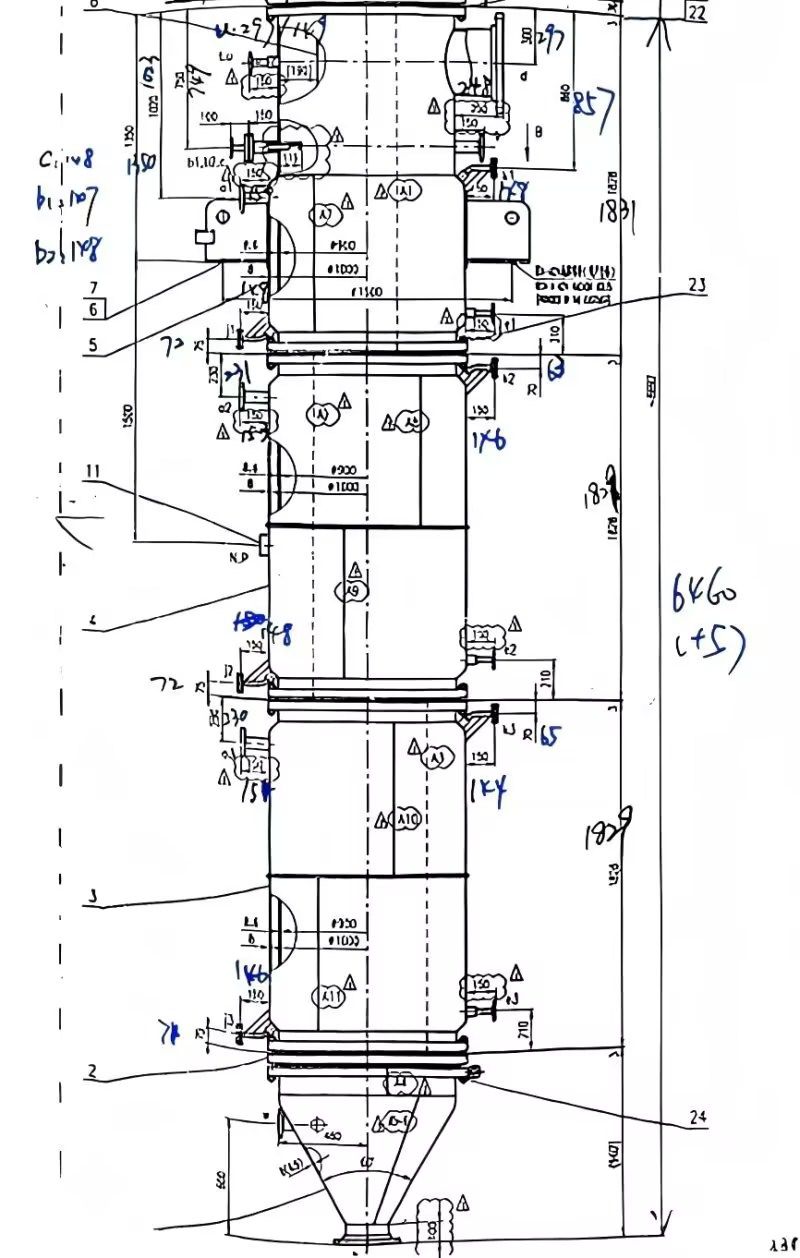
Reports frequently contain numerous tables and data to present inspection results, which is not only time-consuming but also prone to errors. I recommend that inspectors verify the manufacturer's own inspection records for dimensions that have passed self-check, or record measurement data directly beside the annotated dimensions on the equipment drawings. These marked and signed drawings can then be attached to the report. This approach has the added benefit of eliminating the need for reviewers to re-check standards and drawings, and it saves inspectors from recording extensive data. We expect inspectors to dedicate more time to on-site inspection work.
7) Recording and Identifying Sampled Products
For products selected through sampling inspection as required by the ITP, their serial numbers must be recorded upon passing inspection, or permanent identification should be applied whenever possible. This ensures the required sampling quantity is met and prevents future situations on site where it becomes impossible to verify whether a problematic item was part of the originally sampled batch.
8) How to Take Inspection Photos
In addition to equipment quality, report readers also need to understand the equipment's current condition, which requires photographs that reflect its overall state. Furthermore, avoid including photos that depict safety violations (e.g., lack of helmet, safety shoes) in the report. If rectifications are made, it is advisable to include before-and-after comparison photos. Currently, some clients require each photo to display the location and time.
9) How to Create a Visually Appealing Report Layout
A neat and clean inspection report layout reflects an inspector's conscientious and methodical approach. Conversely, a disorganized layout with inconsistent fonts and sizes, or insufficient spacing between paragraphs and photos, makes the report difficult to read and should be avoided. Regularly refer to standards, specifications, and exemplary reports to study their formatting techniques and enhance the visual appeal of your own reports.
Villy Inspection Share-3 - How to Review Material Certificates(MTC): A Practical Guide for Third-Party Inspectors:
Reviewing Material Test Certificates (MTCs) or Mill Test Certificates is the first critical line of defense in ensuring the quality of equipment manufacturing. Its core goes beyond merely "checking information" to encompass verification and traceability.
Based on inspection experience, the following outlines the process and methodology for reviewing MTCs. The core logic is to judge the certificate's compliance, authenticity, consistency, and traceability.
Step 1: Fundamental Compliance Review (Reviewing the Certificate Itself)
1. Verify that the MTC is an original or a clear copy in a formal format, ensuring it contains these essential elements:
2. Issuing Authority: Is it the material producer (e.g., steel mill, fastener manufacturer) or its formally authorized quality department? Certificates issued by trading companies are typically invalid unless they are original manufacturer certificates being forwarded.
3. Standards & Specifications: Does it explicitly list the material standards (e.g., ASTM A106 Gr.B) and inspection standards (e.g., EN 10204 Type 3.1) the product conforms to?
4. Unique Identification: The heat number/lot number, heat treatment batch number, and product serial number are the material's "ID card" for traceability and must be clearly stated.
5. Signatures & Stamps: Does it bear the handwritten or electronic signature of an authorized inspector, along with the company's quality inspection stamp? If provided by a trader, their stamp/signature should also be present.
Step 2: In-Depth Technical Data Verification (Reviewing the Content)
1. Item-by-item, verify that the technical data on the certificate meets the requirements of the Purchase Order and Technical Specifications.
2. Chemical Composition: Compare elements like C, P, S, Cr, Ni, Mo, etc., against the allowable range of the specified standard. This is critical for stainless steels (e.g., 316L), alloy steels, and bolts (e.g., Grade 8.8).
3. Mechanical Properties: Verify tensile strength, yield strength, elongation, impact test, etc. Note that for steel plates, properties may need to be distinguished between transverse and longitudinal directions.
4. Heat Treatment Condition: The heat treatment process record is core for quenched & tempered bolts, normalized or quenched & tempered plates/pipes.
5. Have any additional test requirements from the contract, project specification, or standard been performed and reflected on the MTC?
To be continued...
NANJING VILLY INSPECTION CO.,LTD.
Copyright © Nanjing Villy Inspection Co.,Ltd. All Rights Reserved.